
Best Dry Cabinet for Camera Lenses in India: Size and Buying Guide
A lens can look perfect on Friday and show a faint web inside the glass by the end of the monsoon. Most photographers in India meet this problem once, usually on an expensive lens, and then start looking for a proper dry cabinet for camera lenses. This guide explains what actually goes wrong, how a cabinet fixes it, how to pick the right size, and what to check before you buy.
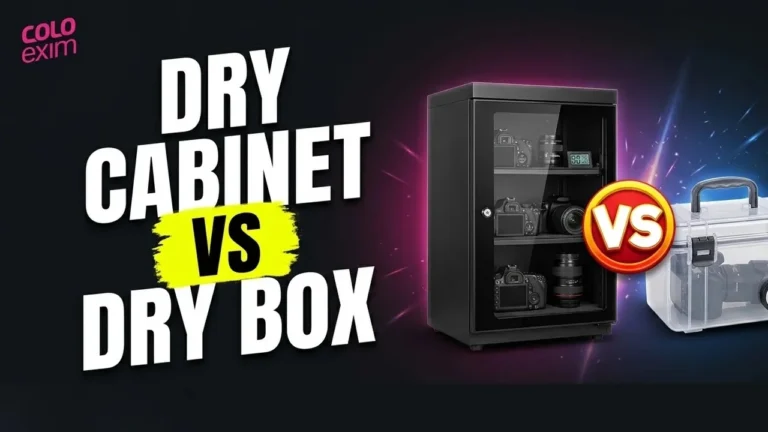
If you only own one kit lens, a small sealed box may be enough. We cover that comparison further down.
Why Indian humidity damages lenses and camera bodies
Lens fungus needs moisture, warmth and a food source. India supplies the first two for most of the year. Mumbai, Chennai, Kochi, Kolkata and Goa stay damp even outside the rains, and inland cities turn humid from June to September. A cupboard in a closed flat with the AC switched off holds that moist air for weeks.
The food source is easier to miss. Fungal spores travel in dust, then settle on fingerprint oil, lint or residue on the glass and grow in still, dark air. Warm, humid, undisturbed conditions give spores the best chance, and a closed cupboard during a monsoon week can hold exactly that kind of air.
Three kinds of damage show up in practice:
- Fungus. Small specks that grow into a web or mesh between elements. It can also work along the edge of cemented elements.
- Haze. A milky film that lowers contrast. Coatings can be etched by the byproducts of fungal growth, which is why early cleaning matters.
- Corrosion. Moisture reaching battery contacts, mount contacts, screws and flash hot shoes on bodies, plus stiff or sticky zoom and focus rings on older lenses.
Once a lens is affected, the usual advice from photography publishers is to take it to a professional rather than fix it yourself. Prevention is far cheaper than any repair, and that is the case for a cabinet.
How a dry cabinet works
A dry cabinet is an insulated, closed cupboard with a way to remove moisture from the air inside. The door stays shut, a sensor reads humidity, and the unit pulls water vapour out until the reading reaches the level you set. There are two broad approaches.
Electronic and thermoelectric cabinets
These use a small powered unit, often a thermoelectric element, to condense and remove moisture. A controller watches the humidity and switches on only when needed. You set a target on the display and the cabinet holds it. Because there is nothing to dry out and refill, upkeep is minimal. The Eirmai cabinets sold by Colo Exim are of this type and use what the brand calls a Smart Thermoelectric AI Controller (STAC), according to the Eirmai dry cabinet page.
Desiccant cabinets and boxes
These rely on silica gel or similar beads that absorb moisture. They need no power, but the desiccant fills up and has to be dried out or replaced. Humidity creeps back up once it is saturated, and you only find out if there is a hygrometer inside.
Neither type fixes a lens that is already infected. A cabinet slows or stops new growth by keeping the air too dry for it. That is the whole job, and it is a useful one.
What humidity should you hold?
Most dry cabinet makers and photography guides suggest holding roughly 40% to 50% relative humidity, with about 45% as a middle target. We could not find a storage humidity figure published by the camera makers, so treat this as common practice, not a specification. Damp air is what fungus needs, and some guides also warn that keeping air extremely dry for years can affect rubber seals and lubricants. If your lens maker gives a figure, follow that.
So bone dry is not the goal. Aim for the middle of the band, around 45%. Check the cabinet you choose can actually be set there. The Eirmai page lists digital humidity control across 25% to 60% RH, which covers the target with room on both sides. Always read the number on your own hygrometer in the first week and adjust the setting if the cabinet reads a few points off.
How to size a cabinet by your kit
Capacity is quoted in litres, and it is internal volume, not shelf count. Buy for the kit you will own in two years, not the kit you own today. Lenses get added faster than people expect, and a packed cabinet leaves no air gap around each item.
The table below follows the Eirmai MRD sizing guidance on the brand page. Capacities and kit suggestions are as listed there.
| Capacity | Eirmai models | Camera bodies | Lenses | Accessories | Suited to |
|---|---|---|---|---|---|
| 20L to 30L | MRD-21C (20L), MRD-30S and MRD-30W (30L) | 1 to 2 | 3 to 5 | Basic | Beginners, single system users |
| 40L to 50L | MRD-45S (40L), MRD-55 (50L) | 3 to 5 | 7 to 10 | Multiple | Enthusiasts, growing collections |
| 70L | MRD-75 | 5 to 8 | 10 to 15 | Extensive | Professional photographers |
| 100L to 120L | MRD-105 (100L), MRD-128 (120L) | 8 to 12 | 15 to 20 | Studio equipment | Studios, multiple systems |
| 160L | MRD-188T (dual compartment) | 12 or more | 20 or more | Large collections | Large studios, rental houses |
Use these as a starting point and adjust for how you shoot. A wildlife photographer with two long telephotos and a couple of bodies fills a cabinet faster than the lens count suggests, because a big lens takes up a lot of room.
Before you order, measure your largest lens with the hood reversed or removed, and ask for the internal shelf dimensions of the model you shortlist. Litres alone will not tell you whether a 400mm lens stands upright inside. The Colo Exim contact page is the quickest way to get that answer for a specific model.
Features to check before you buy
- Humidity control range. You want a range that includes 40% to 50% with margin. The Eirmai page lists 25% to 60% RH.
- Display. You should be able to read humidity at a glance. Eirmai lists LED or touchscreen options depending on model. A visible reading is what tells you the cabinet is working during a long monsoon.
- Door and seal. A cabinet is only as dry as its seal. The page describes a tempered glass door with a magnetic seal. Glass lets you see what is inside without opening the door and letting damp air in.
- Lock. Useful in shared studios, rental counters and homes with children. A key lock is listed.
- Power draw. A cabinet runs around the clock, so draw matters. Eirmai lists 5W for its thermoelectric design.
- Noise. If it sits in a bedroom or edit room, quiet matters. The page lists operation below 20dB.
Treat the specifications above as brand claims taken from the listing, and confirm the exact figures for your chosen model before purchase.
Dry cabinet vs sealed dry box vs silica gel bag
People often ask whether they really need a powered unit. The honest answer depends on kit size and climate. This comparison lays it out.
| Option | How it works | Needs power | Upkeep | Best for | Weak point |
|---|---|---|---|---|---|
| Electronic dry cabinet | Powered unit removes moisture and holds a set humidity | Yes | Low, check the reading now and then | Several lenses and bodies, humid cities, studios | Needs steady power and wall space |
| Sealed dry box with desiccant | Closed box with desiccant beads absorbing moisture | No | Regular drying or replacing of desiccant | One to three lenses, travel, dry months | Humidity rises once desiccant saturates |
| Silica gel bag in a camera bag | Small packet absorbs moisture in a bag or drawer | No | Frequent replacement | Short trips, a stopgap | Little capacity; a sealed bag can trap damp air |
A box or bag is better than leaving gear in an open shelf. For a growing collection in a coastal or monsoon city, a cabinet saves you from tracking desiccant across a dozen containers. If you want a deeper look at the box option, we cover it in a separate guide on dry box versus dry cabinet.
A simple care routine
- Wipe each lens and body with a soft cloth before it goes in. Fingerprint oil is what fungus feeds on.
- Do not store gear that is still damp. After a rain shoot, let it sit open in a dry room first.
- Keep a hygrometer or the built in display visible and note the reading when you open the door.
- Open the door as rarely as you can in the monsoon, and close it fully each time.
- Take lenses out and use them. Light and moving air discourage growth, so a lens that never leaves the cabinet is not the goal.
- Inspect with a torch every few months, looking through each lens for specks or haze.
After a power cut, check the reading once supply returns. If it is high, leave the cabinet running with the door shut until it settles.
Where to buy in India
Colo Exim is the official authorized importer and national distributor of Eirmai in India, as stated on the brand page. That matters for dry cabinets because you want the correct model, proper support and advice on capacity from the people who handle the range every day. You can read the full lineup on the Eirmai India page, and browse other equipment we distribute on the brands page.
If you are unsure between two sizes, send us your list of bodies, lenses and accessories and we will suggest a model. Ask us directly for anything specific to your order.
Make an inquiry or call us on +91 93204 96801.
Frequently asked questions
What humidity should a dry cabinet for camera lenses hold?
Dry cabinet makers and photography guides commonly suggest about 40% to 50% RH, with around 45% as a middle target. We could not find a storage figure published by the camera makers, so treat this as common practice. Check the reading on your own hygrometer and follow your lens maker advice if it gives one.
How big a dry cabinet do I need?
It depends on bodies, lenses and accessories. Eirmai suggests 20L to 30L for 3 to 5 lenses, 40L to 50L for 7 to 10 lenses, and 70L for 10 to 15 lenses. Buy for the kit you will own in two years.
Does a dry cabinet remove fungus that is already on a lens?
No. A cabinet keeps the air too dry for new growth. A lens that already has fungus should be assessed by a service centre or optical professional.
Is a silica gel bag enough in the Indian monsoon?
A small packet has little capacity and saturates quickly in damp weather. It helps for short trips, but a larger kit in a humid city is better served by a cabinet or a sealed box with ample desiccant.
Does a thermoelectric dry cabinet use a lot of power?
Eirmai lists 5W power consumption for its thermoelectric cabinets. Confirm the figure for your exact model before you buy.
Who is the authorized Eirmai distributor in India?
Colo Exim is the official authorized importer and national distributor of Eirmai in India, as stated on the Eirmai brand page.