Dry Cabinet vs Dry Box for Lenses: Which One Do You Need in India?
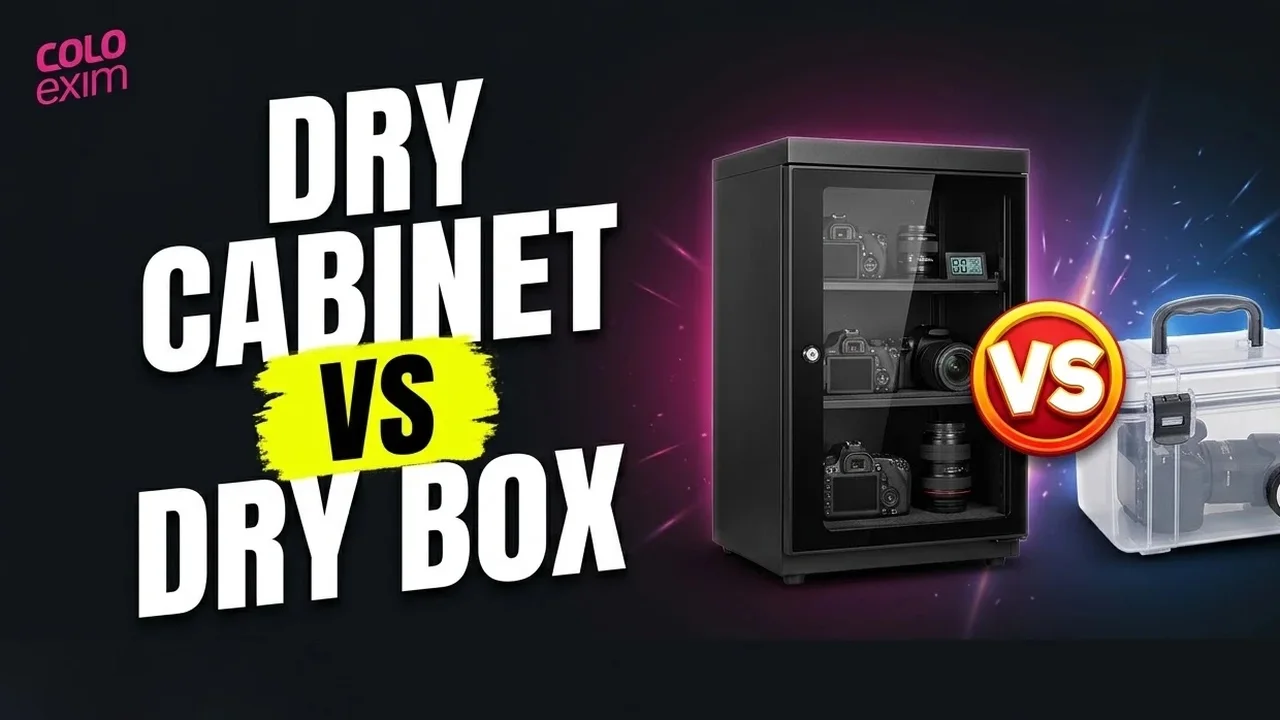
Every few weeks a photographer asks us the same thing: is a dry box for lenses enough, or should I buy a powered cabinet? Both work. They suit different kits, different cities and different habits, and picking the wrong one means either spending on capacity you never use or trusting a box that cannot keep up with a Mumbai monsoon.
This guide helps you decide, explains how to check a lens for fungus, and covers storage for travel and the rainy months.
What a dry box actually does
A dry box is a sealed container, usually plastic, with a lid gasket and a space for desiccant such as silica gel. Some include a small hygrometer. The desiccant absorbs moisture from the trapped air, which lowers humidity inside. It has no moving parts and needs no socket.
The limit is simple. Desiccant has a fixed capacity. Once it is full, humidity inside the box drifts up toward the outside air. Silica gel needs recharging once it is saturated, and indicator crystals change colour to show it, so check your product guide for which colours mean active and which mean saturated. Photography guides commonly suggest about 40% to 50% RH for storing lenses, so a box with a hygrometer lets you see whether you are actually holding that.
When a dry box is enough
A box does the job in these situations:
- Small kit. One body and two or three lenses fit comfortably in a single box with room for desiccant.
- Dry climate or dry months. Where indoor humidity stays low for most of the year, desiccant lasts longer and needs less attention.
- Travel. A compact box or sealed case protects a lens in transit and takes no power.
- A second location. Many people keep a box at a relative’s house or a shoot location, with the main kit in a cabinet at home.
- A stopgap. A box is a sensible first step while you work out how big your kit will become.
The catch is routine. You must dry or replace the desiccant often enough that it never sits saturated through a wet week. Skip a month in July and the box can be doing nothing at all.
When a powered cabinet is worth it
A powered dry cabinet removes moisture on its own and holds the level you set, so it does not depend on you remembering a refill date. It makes more sense when:
- You live in a coastal or high humidity city, where the air stays damp across many months.
- You own several lenses and bodies, so one box would be crowded and several boxes become a chore.
- You shoot professionally and a lens out of action for repair means a lost job.
- Equipment is shared among a team, rented out or kept in a studio.
- You travel often and cannot check on gear at home.
Eirmai dry cabinets sold by Colo Exim use a thermoelectric controller, which the brand calls a Smart Thermoelectric AI Controller (STAC). The Eirmai page lists digital humidity control across 25% to 60% RH, a tempered glass door with a magnetic seal, a key lock, LED or touchscreen display options, operation below 20dB and 5W power consumption. These are brand specifications, so confirm the figures for the exact model you pick.
Capacity and cost of ownership, without the price tags
The cheapest option on day one is rarely the cheapest over five years. Think about these running costs instead of the sticker:
- Your time. A box needs desiccant checks, drying and replacements. A cabinet needs a glance at the display.
- Consumables. Boxes use desiccant that you dry out or replace. Cabinets of the thermoelectric type do not.
- Electricity. A powered cabinet runs continuously. Eirmai lists 5W for its thermoelectric models, which is a small continuous load. Check the figure for the model you want.
- Number of containers. Four boxes mean four hygrometers and four desiccant schedules.
- The cost of a bad outcome. One fungus affected lens can cost more to deal with than the storage that would have prevented it.
On capacity, remember that litres measure internal volume. Long telephotos, lens hoods and bodies with grips use space quickly. Eirmai suggests these kit sizes on its brand page:
| Capacity | Eirmai models | Camera bodies | Lenses |
|---|---|---|---|
| 20L to 30L | MRD-21C, MRD-30S, MRD-30W | 1 to 2 | 3 to 5 |
| 40L to 50L | MRD-45S, MRD-55 | 3 to 5 | 7 to 10 |
| 70L | MRD-75 | 5 to 8 | 10 to 15 |
| 100L to 120L | MRD-105, MRD-128 | 8 to 12 | 15 to 20 |
| 160L | MRD-188T (dual compartment) | 12 or more | 20 or more |
Buy for the kit you expect to own in a couple of years. A cabinet that is full on day one leaves you buying a second storage solution soon after.
How to tell if a lens already has fungus
Do this check in a dim room with a bright torch. Remove both caps, hold the lens up, and shine the light through from one end while looking in from the other. Rotate the lens slowly and look at different angles. Open the aperture wide if the lens allows it.
- Fungus. Thin threads, a branching web, or small round clusters of spots sitting inside the lens, not on the outside surface. They do not wipe off.
- Haze. A milky glow or loss of sparkle in the beam, which can come from fungus, oil film or old lubricant.
- Dust. Loose specks. A little dust inside most lenses is normal and rarely affects pictures.
- Surface dirt. Marks that wipe away with a blower and a clean microfibre cloth are not fungus.
Images can also hint at a problem. A guide on humidity and cameras describes soft patches in photos that look like a fingerprint smudge, and says growth can sit between elements and under the coating. If your shots lose contrast with a new softness in one area, check the glass.
A torch test is not a diagnosis. Some marks that look like fungus turn out to be something else, and the reverse is also true. If you are unsure, a service centre can confirm it.
What to do if you find fungus
Use these steps as general guidance, because the right move depends on the lens, how far it has spread and what the lens is worth to you.
- Isolate it. Keep the lens away from your other gear so spores do not spread through shared storage.
- Do not open the lens yourself. Removal should be done by a professional. Fungus can sometimes be cleaned from accessible surfaces, but it can mark the glass permanently, so for a valuable lens talk to the manufacturer service centre or an optical specialist.
- Ask a service centre or optical technician. Get an opinion on whether the lens can be cleaned and what condition it is likely to be in afterwards.
- Fix the storage. A cleaned lens returned to a damp cupboard can get it again. Sort the humidity before it comes home.
- Check neighbours. Inspect the other lenses and the camera bags that sat nearby.
Be wary of home remedies. Rubbing a lens with vinegar or similar mixtures is sometimes mentioned for plain window glass, but a camera lens has coatings that you can easily damage.
Storing lenses for travel and the monsoon
On the road
- Pack lenses with caps on, in padded pouches, inside a bag with fresh desiccant.
- Do not seal damp gear away. After a wet or humid shoot, let bag and lenses dry in open, shaded air before closing the case.
- In hotels, take lenses out of the bag at night and keep them in a dry spot away from the bathroom and the AC outlet.
- Moving from an air conditioned room to humid outside air will fog the glass. Give the lens a few minutes in its bag to adjust before uncapping.
- On long trips, a compact dry box with a hygrometer shows you what is happening, where a loose packet only guesses.
At home in the rains
- Avoid drawers, cupboards and storerooms. The humidity guide cited here recommends against them and prefers a dry box made for cameras.
- Use your gear. Light and fresh air discourage growth, so a lens that gets taken out regularly is safer than one that stays shut away for months.
- Clean before storing. Fingerprint oil and lint feed fungus.
- Do not open the cabinet or box more than you need to in humid weather, and close it fully each time.
- Check desiccant weekly during the monsoon if you use a box, then monthly once the air dries out.
A quick way to decide
Count the lenses you own and the months your city stays damp. With one to three lenses in a dry city, a box with a hygrometer is a reasonable choice. With four or more lenses, or any kit in a coastal or monsoon city, a powered cabinet usually repays the outlay in saved attention alone. When in doubt, shortlist a cabinet one size larger than your current kit.
Where to buy Eirmai in India
Colo Exim is the official authorized importer and national distributor of Eirmai in India, as stated on the brand page. Read the full range on the Eirmai India page, and see the other brands we distribute on our brands page. If you cannot decide between two sizes, share your gear list through the contact page and we will suggest a model.
Make an inquiry or call us on +91 93204 96801.
Frequently asked questions
Is a dry box for lenses enough in India?
For one to three lenses, dry months or travel, a sealed box with fresh desiccant and a hygrometer can be enough. In coastal or monsoon cities, or with a bigger kit, a powered cabinet is easier to rely on.
How often should I change silica gel in a dry box?
Recharge or replace it when it is saturated. One guide describes orange or blue crystals as active and green or pink as saturated. In the monsoon, check weekly.
How can I tell if a lens has fungus?
Shine a torch through the lens in a dim room. Fungus looks like thin threads, a web or round clusters inside the glass that do not wipe off. If unsure, ask a service centre.
Can I clean lens fungus myself?
It is better not to. Guidance cited here says removal should be done by a professional, and acidic byproducts can permanently damage glass. Ask the manufacturer or an optical technician.
What size Eirmai cabinet suits a small kit?
Eirmai suggests the 20L to 30L models (MRD-21C, MRD-30S, MRD-30W) for 1 to 2 bodies and 3 to 5 lenses. Larger kits move up to the 40L to 50L range and beyond.
Who sells Eirmai dry cabinets in India?
Colo Exim is the official authorized importer and national distributor of Eirmai in India, as stated on the Eirmai brand page.